By Peggy Arthur
Greetings, readers, writers, and everyone in between.
When we learn early American history, the story usually moves in one direction, north toward freedom or west across the frontier. But after traveling through South Carolina’s Lowcountry and into St. Augustine, Florida, I discovered a different path entirely.
One that runs south.
My journey began in Charleston at the International African American Museum. Built on Gadsden’s Wharf, where an estimated 40 percent of enslaved Africans brought into British North America first arrived, the museum grounds visitors in the reality of the transatlantic slave trade. Standing there, you can feel the weight of history beneath your feet.
Like many people, I grew up believing the Underground Railroad pointed only north toward Canada. During my childhood in Kentucky, I visited a Shaker community and learned about its role in helping enslaved people escape. But traveling farther south into St. Augustine revealed a lesser-known truth: for some, freedom meant going deeper into the South.
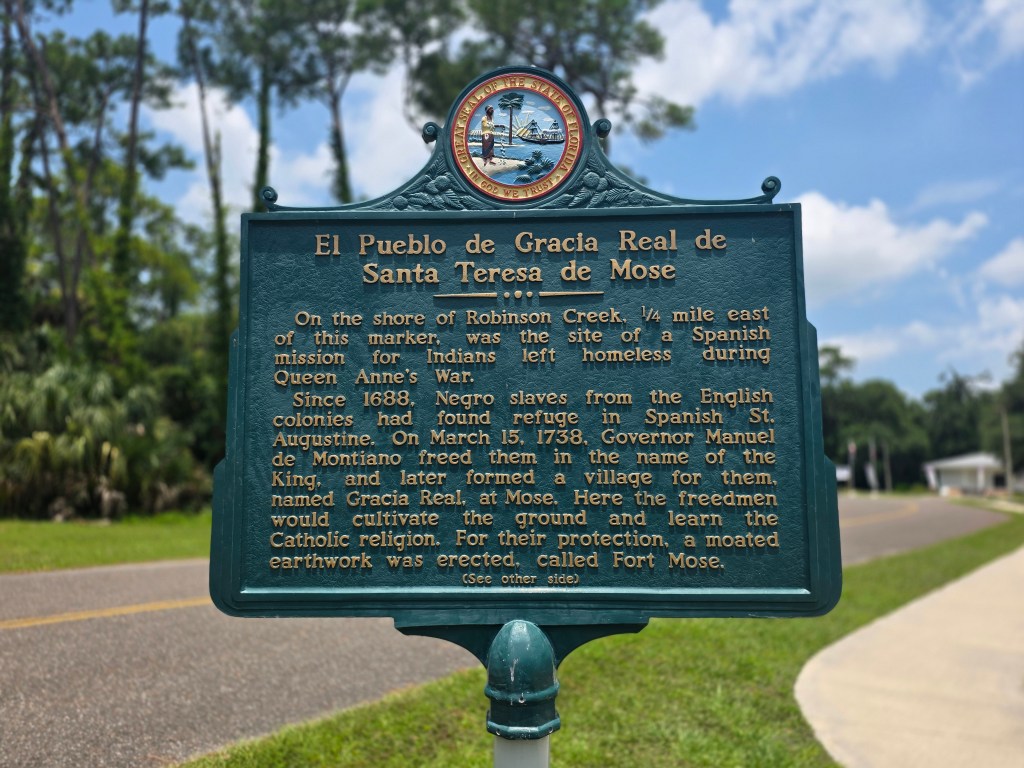
In 1693, the Spanish Crown issued a royal decree offering freedom to enslaved people who escaped from the British colonies. The conditions were straightforward: convert to Catholicism, contribute to the community, and serve in the Spanish militia. For those willing to risk the journey, Spanish Florida became a place of refuge.
Between the late seventeenth and mid-eighteenth centuries, enslaved men and women fled plantations throughout the Carolinas and Georgia, traveling hundreds of miles through swamps, forests, and hostile territory. In 1738, this movement led to the founding of Gracia Real de Santa Teresa de Mose—known today as Fort Mose Historic State Park. Located just north of St. Augustine, Fort Mose became the first legally sanctioned free Black settlement in what is now the United States.
Visiting Fort Mose brought this history to life. It was more than a place of refuge; it was a thriving, fortified community led by Captain Francisco Menéndez. Its residents were not passive participants in history. They were soldiers, landowners, and defenders of Spanish Florida who fought to preserve the freedom they had earned.
While in St. Augustine, I also explored St. George Street, often recognized as one of the oldest streets in the United States. Just steps away lies the Plaza de la Constitución, the city’s historic public square established during the Spanish colonial period. During the British occupation of Florida (1763–1784), enslaved people were bought and sold in and around the plaza. The market pavilion standing there today was built in the early nineteenth century and continues to serve as a gathering place woven into the daily life of the city.
Nearby stands the Castillo de San Marcos, the oldest masonry fort in the continental United States. Construction began in 1672 and was completed in 1695 using coquina stone quarried from nearby Anastasia Island. Enslaved Africans, Afro-Spanish laborers, and Indigenous people, particularly the Timucua, quarried, transported, and built the fort’s massive walls. Their labor, often omitted from traditional narratives, quite literally created one of North America’s most enduring landmarks.
Perhaps one of the most surprising discoveries from this journey was learning that people of African descent were present during the earliest years of European exploration in the Americas. Historical evidence shows that free Africans and Afro-Iberians participated in some of the earliest Spanish expeditions, reminding us that Black history in the Americas did not begin solely with enslavement. Their stories challenge a narrative that too often starts centuries after Black people had already become explorers, sailors, interpreters, craftsmen, and pioneers.
One contrast stayed with me long after the trip ended.
In Charleston, the historic slave market has been preserved as a museum; a space designed for reflection, education, and interpretation.
In St. Augustine, the plaza associated with the buying and selling of enslaved people remains an open public square where daily life continues all around it.
Two places.
Two approaches to memory.
One invites you inside to learn.
The other asks whether you’ll recognize history standing in plain sight.
Traveling through these places became more than sightseeing. It became an act of unlearning.
History is often presented as a straight line, but this journey reminded me that it is anything but. The pursuit of freedom did not follow a single path, nor did the contributions of African people begin with bondage. From Charleston’s harbor to the coquina walls of St. Augustine, I was reminded that our ancestors were never simply subjects of history. They were navigators, craftsmen, builders, soldiers, and pioneers. They pursued freedom in more than one direction; north, south, and beyond the boundaries we were taught to imagine.
Sometimes the most powerful stories aren’t the ones history forgot.
They’re the ones history whispered, waiting for someone willing to listen.
🌿 Continue the Conversation
What historical place has challenged something you thought you knew? I’d love to hear about the moments that have reshaped your understanding of history.
If this article resonated with you, consider sharing it with someone who loves history, travel, or discovering the stories that deserve to be remembered.
Until next time,
Keep reading. Keep writing. Stay rooted in truth.
If you enjoy exploring overlooked history, mythology, and the research that inspires my fiction, subscribe to the blog so you never miss a post. You can also explore more essays, book reviews, and updates on my writing journey.
📩 Subscribe below
#BlackHistory #SouthernGothicTravels #AfricanAmericanHistory #WritingResearch #TravelWithPurpose


Leave a comment