By Peggy Arthur
Greetings, readers, writers, and everyone in between.
There is a distinct phase in revision when digital documents betray you. When a project reaches critical mass, the sheer volume of text overwhelms the screen, and the story must be radically simplified to be understood.
When a manuscript grows to a certain length, scrolling through a word processor stops feeling like navigating a story. It starts feeling like wandering through a labyrinth with a weak flashlight, and I mean Pan’s Labyrinth, not the manicured hedges of Bridgerton. You shift a dramatic confrontation from Act Three into Act Two, pull an atmospheric scene forward to tighten pacing, and before you know it, ghost scenes, timeline fractures, and duplicate beats linger in the shadows of the final hundred pages.
That is exactly where I found myself this week: staring down the final 100-page stretch, knowing the finish line was in sight, but recognizing that the scaffolding needed an audit.
Stepping Away from the Screen
Before you can polish sentences, you have to verify the architecture. When material gets rearranged during developmental edits, the back third of the book inevitably inherits the fallout: orphaned dialogue, abandoned subplots, and narrative echoes.
Trying to resolve structural debt on a backlit screen is an uphill battle. The brain gets lulled by familiar prose; you end up reading redundant passages three times and second-guessing your transitions because scrolling creates an illusion of continuity that isn’t actually there.
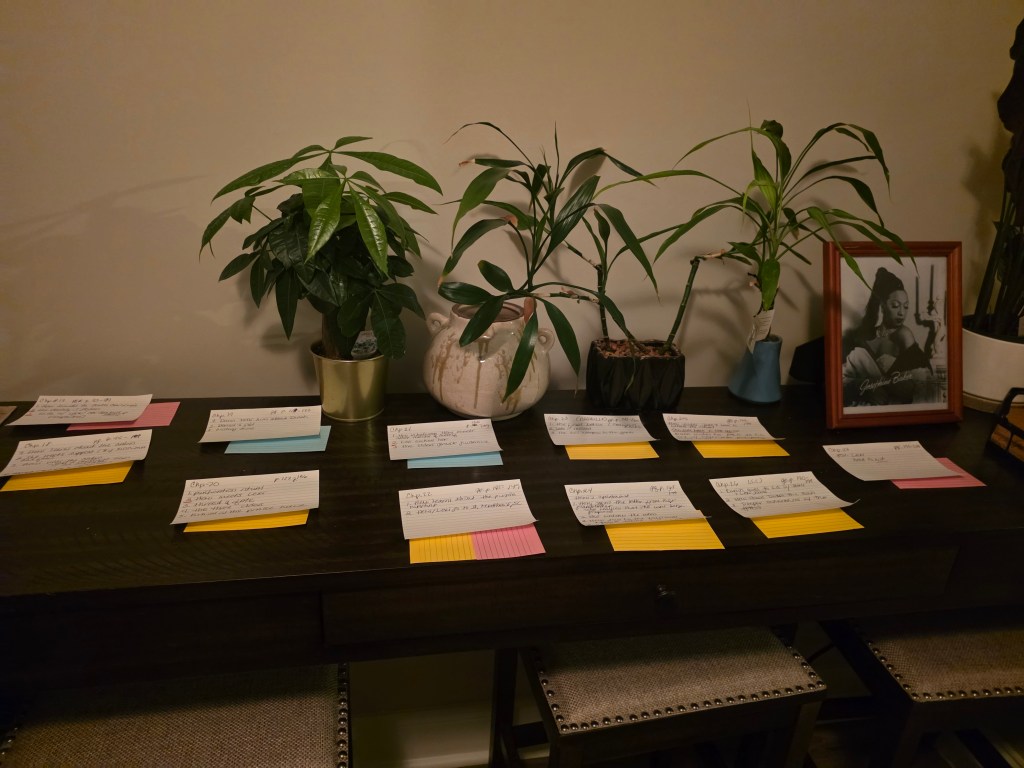
So, I closed the laptop, cleared off the table, and broke out the index cards.
The Indexing Method
Index carding isn’t just an outlining tool for day one. It is one of the most ruthless diagnostic instruments a writer has during late-stage revision. It externalizes your mental load, translating 80,000 abstract words into discrete physical modules you can inspect, reorganize, and stress-test.
Rather than tracking every minute beat, I adopted a chapter-by-chapter approach to untangle this final block. One white card represents one chapter, capturing only high-level narrative data:
Page range and word count
Core dramatic shift (the “value change” from scene start to finish)
Setting and active cast on stage
From there, color-coding does the heavy lifting:
Green (The Anchors): Climactic sequences and key reveals that land cleanly, serve their narrative purpose, and remain untouched.
Red (The Ghosts): Chapters that no longer carry narrative weight, including redundant beats, scrapped subplots, and leftover fragments from scenes already harvested upstream. These get retired directly to an archive file.
Yellow (The Hybrids): Chapters holding sharp dialogue or vital thematic turns that survived earlier cuts but now need to be rebuilt around recent structural changes.
What the Physical Cards Reveal
There is something profoundly grounding about holding a story’s structural flaws in your hands. On paper, duplicates can’t hide behind a flick of the trackpad. A timeline plot hole isn’t a vague worry hovering in the back of your mind; it is an unmistakable, glaring void between a yellow card and a green one.
Indexing forces you to stop reading your story and start analyzing its mechanics. Right now, the task isn’t line editing or hunting for the perfect metaphor. It is laying down a clean, load-bearing runway so the ending lands with precision.
Once the duplicates are cleared out and the structural map locks into place, the real line polishing can begin. But for today, the table belongs to the cards. It’s spades, not Uno.
Until next time, fellow creators!
Let’s see this through.
🌿 Continue the Conversation
How do you diagnose structural chaos when the digital draft betrays you? Are you team physical index cards, whiteboard warrior, or are you one of those rare, mythical creatures who actually figured out how to use Scrivener without getting stranded on page two of the instruction manual?
(Full disclosure: I bought Scrivener last year with grand ambitions, opened the tutorial, and promptly closed the app forever. If you’ve mastered it, don’t tell me. Let me preserve my analog peace.)
Drop your revision weapon of choice in the comments below!
Until next time,
Keep reading. Keep writing. Stay rooted in truth.
If you enjoy exploring overlooked history, mythology, and the research that inspires my fiction, subscribe to the blog so you never miss a post. You can also explore more essays, book reviews, and updates on my writing journey.
📩 Subscribe below
#StoryStructure #AuthorLife #AmEditing #Indexing #WritingCommunity #NovelRevision


Leave a comment