By Peggy Arthur
Greetings readers, writers, and everyone in between!
Last weekend, I found myself leaning into the quiet vibrations of spring. That energy led me, almost unexpectedly, to pause and read a historical marker tucked into my neighborhood. It marked a tree; one that had survived the devastating sweep of Dutch Elm disease that wiped out most of the elms across the United States.
This tree is over 300 years old. Almost as old as the state itself.
In the old world, in Europe, it’s not uncommon to be surrounded by relics of the past. But here in the United States, moments like this feel rare, easy to overlook unless something calls your attention to them.
For me, it wasn’t the marker at first.
It was the red squirrels. Playfully darting up and down the trunk, alive with motion and urgency—that made me stop.
And once I did, I really saw the tree.
I stood there, taking in the width of its trunk, wondering how far down its roots must stretch. I imagined the rings hidden within it. Each one marking a year, a season, a moment in time. I imagined it as a seed, something small and unassuming that grew into a quiet giant.
My mind drifted to the trees I studied while researching Charleston for The Pretender’s Game. The ones draped in moss. The ones that seemed to hum with memory.
And maybe it’s the child in me. The 80’s baby who grew up watching FernGully. I’ve always believed that trees carry something more.
That they have spirits.
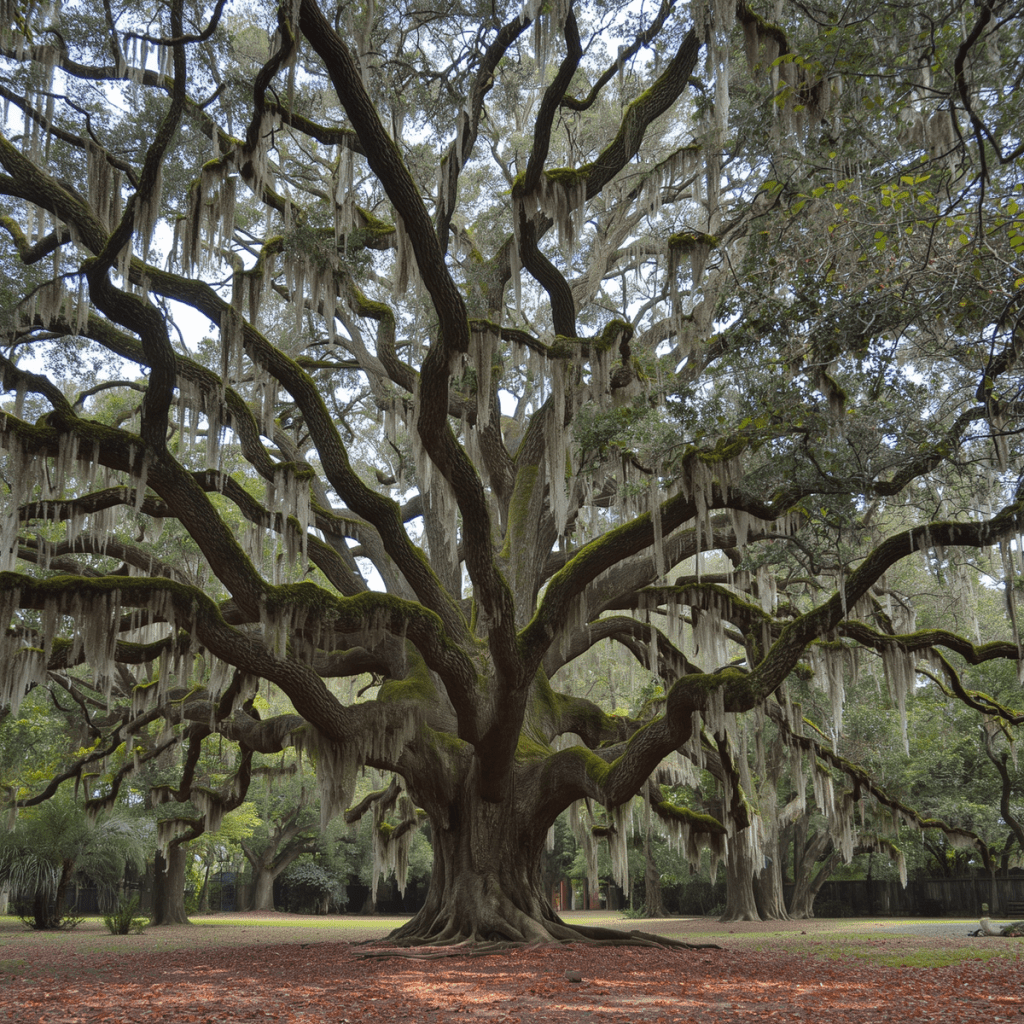
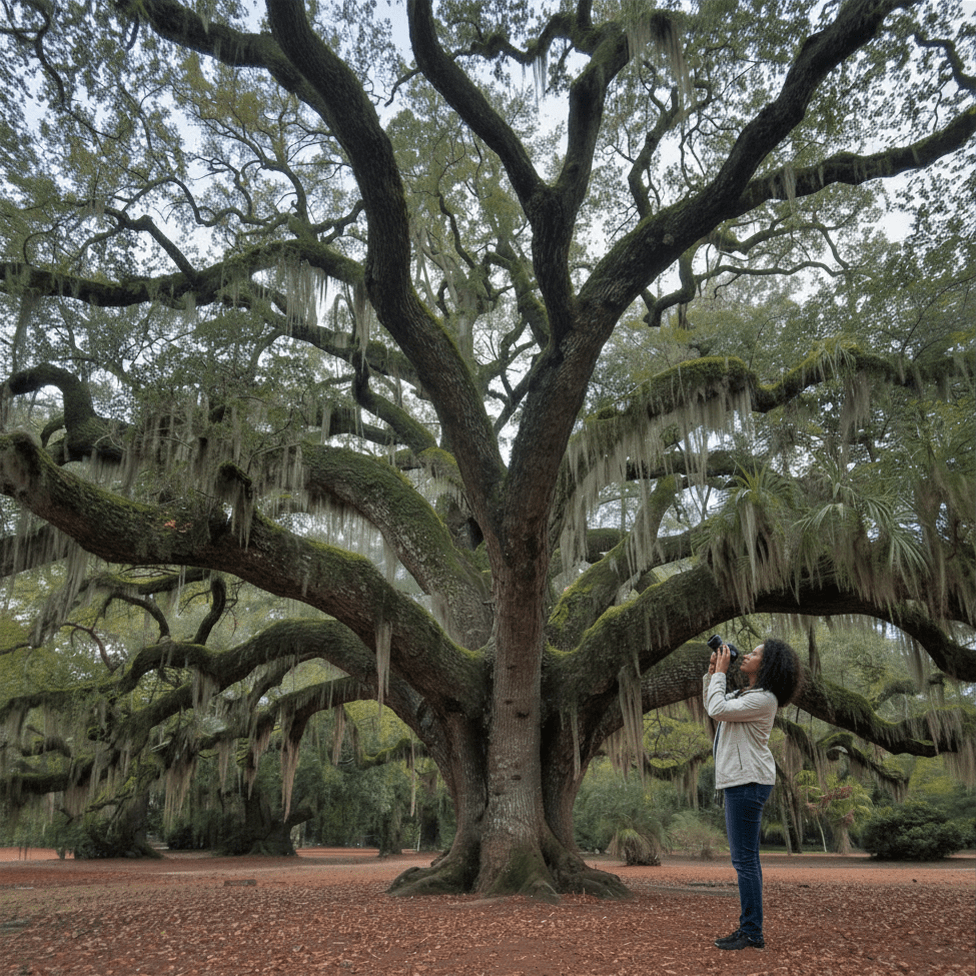
Just outside Charleston, on Johns Island, stands one of the most extraordinary living beings in the American South: the Angel Oak Tree.
Estimated to be between 400 and 500 years old, this Southern live oak has quietly witnessed centuries of history beneath its sprawling canopy. Long before paved roads, neighborhoods, and modern Charleston existed, the Angel Oak was already stretching its branches toward the sky.
The tree stands about 65 feet tall, but it’s true wonder lies in its reach. Massive limbs extend outward in every direction, some stretching nearly 190 feet, shading more than 17,000 square feet of ground.
Walking beneath it feels less like standing under a tree and more like entering a natural cathedral.
But the Angel Oak is more than a marvel of nature.
It is a keeper of memory.
A Tree Rooted in History
The land where the Angel Oak grows was once part of a colonial land grant from 1717. The tree itself takes its name from Justus and Martha Angel, whose family owned the property during the nineteenth century. Yet the story surrounding the tree stretches much further back.
Long before European settlement, the Lowcountry was home to numerous Native American tribes who gathered in natural spaces, beneath trees, along rivers, within forests.
Ancient trees like this one often symbolized strength, protection, and continuity.
Witness Trees: Nature as Memory Keeper
Across North America, there is a concept known as a “witness tree.”
A witness tree is one that has lived long enough to observe history—wars, migrations, treaties, generations of people passing beneath its branches.
In the 1700s and 1800s, surveyors even used trees as boundary markers, trusting that they would outlive the people who recorded them.
But the idea that trees hold memory didn’t begin there.
For many Native cultures, trees are living beings within a larger community of life. Not just part of the land, but participants in it. Observers. Holders of story.
Standing beneath a tree like the Angel Oak, it becomes easy to understand why.
Spiritual Connections in the Lowcountry
The Angel Oak also holds meaning within the Gullah Geechee people, descendants of enslaved Africans who lived along the coastal regions of South Carolina and Georgia.
Across many African and African diasporic traditions, nature carries deep spiritual significance.
Trees, especially ancient ones, become spaces of reflection, prayer, remembrance, and ancestral connection.
For generations, families gathered beneath these branches. Stories were told. Silence was shared.
Some even say the tree is protected by spirits.
And many who visit still describe feeling something. An unexplainable calm, a presence, an energy.
Whether spiritual truth or poetic understanding, the meaning remains:
This is more than just a tree.
A Living Witness Through the Centuries
Over its long life, the Angel Oak has endured:
- centuries of coastal storms
- hurricanes sweeping through the Lowcountry
- the rise and fall of plantations
- the end of slavery and generations beyond
- the rapid expansion of modern Charleston
And still. It stands.
Its branches stretching wider with each passing generation.
Today, hundreds of thousands of visitors travel to Johns Island each year for a single experience:
To stand beneath something that has endured.
Something that remembers.
Inspiration for The Pretender’s Game
When I began developing the South Carolina setting for The Pretender’s Game, the landscapes of Johns Island and the Lowcountry became more than scenery.
They became part of the story.
The moss-draped trees, tidal marshes, and quiet back roads carry a feeling that the land itself remembers.
Places like the Angel Oak remind us that history is not only written in books.
It is written in roots beneath the soil.
In branches reaching skyward.
In the quiet endurance of the natural world.
Sometimes, the oldest witnesses are still standing.
🌿 Join the Conversation
Have you ever encountered a place—or even a tree—that felt like it held memory?
I’d love to hear your experience. Drop a comment below and share your story.
If this piece resonated with you, please share it with a fellow reader or writer who appreciates the deeper layers of history, spirit, and storytelling.
And if you haven’t already, be sure to subscribe so you don’t miss the next step in this journey.
✨ Step into the circle. The story is still unfolding.
📩 Subscribe below and step into the circle of readers and storytellers.
#SouthernGothic #SouthernLore #HauntedSouth #StoriesOfTheSouth


Leave a Reply